Why a downloaded checklist stops working by week three
A generic cleaning checklist template describes a home that does not exist. It assumes a mudroom. A second bathroom. A formal dining room, and a laundry room on the bedroom floor. Your home has two of those and none of the rest, so half the lines are dead on arrival and the ones you actually need were never written down in the first place. People do not abandon these lists for lack of discipline. They abandon them for a duller reason. The list stopped describing the building they live in.
The four decisions that make it usable
The fix is small. Borrow the structure, write your own contents. Four decisions make a checklist usable: how it is grouped, what order the lines run in, how often each task repeats, and who is responsible for it.
Group by room, not by task type
The most common structural mistake is grouping by activity. All the dusting together, all the vacuuming together, all the wiping together. It reads tidily and works badly. You do not clean a home in activities. You clean it in places, and a dusting block walks you through every room with one tool, then sends you round the identical loop again with the next one.
Where the gaps become obvious
Room grouping also makes coverage visible. Under a heading like Main bathroom, an unticked line is plainly unfinished. Nothing to interpret. In a task-grouped list, "wipe switch plates" is a single line standing in for six rooms, and nobody reading it afterwards can tell whether it meant all six or only the one you happened to walk past.
Add the spaces templates always skip
Write your headings from your own floor plan. Use the order you would walk them. Then add the spaces templates always skip. The entry. The stairs. The hallway. The balcony door. If a space has a surface, it earns a heading.
Order the lines so gravity works for you
Within each room, sequence matters more than completeness. Dust falls. Clean the floors before the shelves, light fittings and ledges above them, and the room is grey again within minutes, which is the commonest reason a room cleaned properly still looks wrong an hour later. So order every block from high to low. Reachable high points first, then furniture surfaces and fixtures, then trim and baseboards, and floors last of all, so that whatever you knock loose on the way down lands on a surface you have not reached yet.
Waiting time first, mess before cleanup
Two other rules save real time. Put anything with a waiting period near the top of its block, so the product sits and works while you are somewhere else, because the twenty minutes a limescale spray needs is twenty minutes you could be spending on the mirror and the bin. And put anything that makes mess above anything that clears it, which is why counter and sink work belongs above sweeping, and why nobody should be mopping a bathroom floor before the sink has been scrubbed. Number the lines. Do not bullet them. Numbers read as deliberate to whoever picks the list up next.
Add a frequency column: weekly, monthly, annual
A flat list forces an impossible choice. Hold only the weekly work and you forget everything else, while a list that holds everything looks unachievable every time you open it, which is how a good template ends up face down in a drawer. A frequency column solves that without splitting the template into separate documents. Keep one master list per room. Mark each line W, M, or A.
What belongs in each of the three levels
Weekly lines are what visibly degrades in seven days. Floors, surfaces, sinks, toilets, bins, linens. Monthly lines are what nobody notices until it is done: appliance fronts and interiors, under furniture, light fittings, door frames, cabinet fronts, every one of which looks unremarkable right up to the week it finally gets done. Annual lines are seasonal projects. They run better as their own pass than squeezed into an ordinary week. Once the structure exists, the weekly cleaning checklist and the spring cleaning checklist are useful places to borrow contents from, though you should take the lines and leave the rooms, since their rooms are no more yours than the mudroom in the template was. Resist a fourth level. Resist a fifth. Almost nobody tracks quarterly.
Leave a column for who does it
The column most templates omit is the one that decides whether a shared household ever uses the list, because a task with nobody's name against it is a task belonging to whoever cracks first. With no name beside a line, every task defaults to whoever notices first, and that person ends up doing all of it while quietly believing the work is shared. Assign by room, not by individual task. Whole rooms are easier to hand over, easier to judge as finished, and far less prone to negotiation at nine on a Sunday evening, when nobody wants to work out which half of the bathroom was whose.
A blank entry is information
Leave the entry blank for anything genuinely unassigned. A blank is information. It is usually the first thing to get outsourced. Use the same column to mark what leaves the household altogether, which is also the quickest way to see what a recurring cleaning plan would have to cover in your home.
Draft it in one walkthrough
Do not build the list at a desk from memory. Walk the home. Stand in each doorway and write down what you can see that needs attention, working down from the ceiling, because a list built at the kitchen table will contain the tasks you resent and none of the ones you have stopped noticing. The doorway view catches what a memory-built list always misses. The vent above the shower. The runner by the door. The ledge over the stairs.
Phrase each line so anyone can finish it
Write tasks as a verb plus a specific object. "Tidy the kitchen" is a mood. "Wipe counters and backsplash" is something another person can finish the way you would have. Anything under two minutes that happens daily belongs in a short reset line at the top of the page, not as an entry of its own.
Worked example: a one-bedroom condo
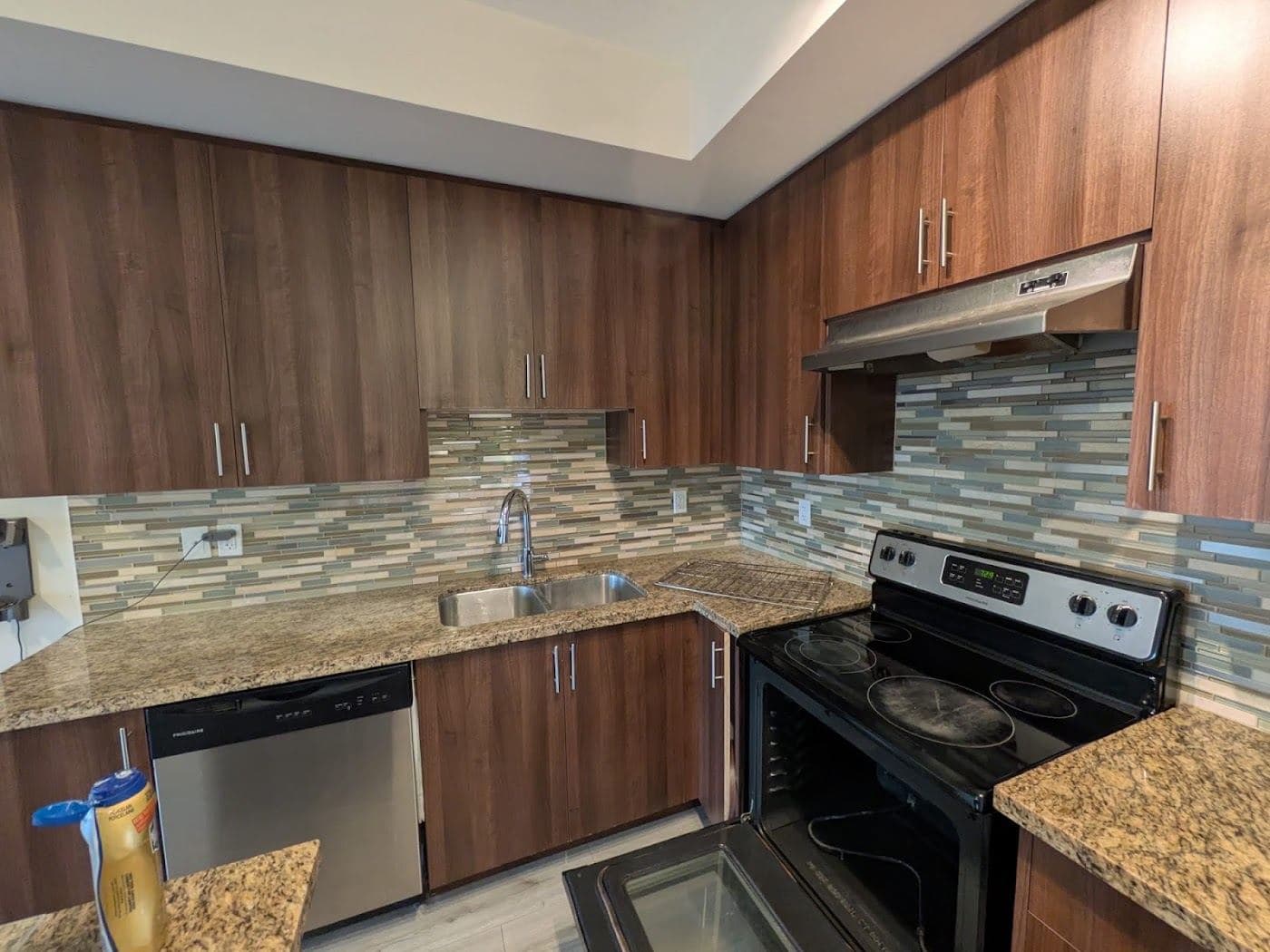
A condo breaks a generic template in a specific way. The rooms are fewer, but they are not simpler, and several of them turn out to be the same room, which is why a template written for a house leaves a condo with three separate headings covering one continuous space. Kitchen, dining and living often share that space, so three template sections collapse into a single heading with a longer block underneath, and the block has to run in walking order because there is no doorway to tell you where one job ends. The entry does more work than in a house. Everything and everyone arrives through it.
The five headings a condo needs
A realistic structure is five headings. Entry and hallway. Main living and kitchen area. Bathroom, bedroom, and balcony or laundry closet. The weekly load is light enough to fit one page, so the monthly lines can live on that page too, which is the one genuine advantage a condo holds over a house when it comes to keeping a checklist current. Then watch for the condo-specific lines no house template includes: an in-suite laundry stack, balcony door tracks, the building bin routine, and the way cooking residue travels further in a small space. Scope for apartment cleaning is described the same way. By zone, not by room count. Delete the garage. Delete the basement and the second bathroom. A list you skim is a list you stop reading.
Worked example: a three-bedroom house
The same template adapted for a three-bedroom house needs the opposite treatment. Two problems now. Repetition and circulation. The bedroom block gets written once and repeated three times. The honest version then marks two of those three at a lower frequency, because a guest room used twice a year does not need what a room somebody sleeps in every night needs.
The headings a house adds
Add the headings a condo never needs. Stairs and landings. Second bathroom, laundry room, back door. Any basement or garage in use. Stairs earn a heading of their own instead of being folded into hallways, since they collect more than a hallway does and they are the most commonly skipped surface in the home. Split the sheet by floor.
Rotate the weekly block if it will not fit
Frequency does more work in a larger home. If the full weekly block cannot realistically be finished, rotate. Bedrooms and the upstairs bathroom one week, the main floor the next, with kitchen and entry staying weekly throughout, since those two are the rooms a visitor walks into and the rooms the household wears out fastest. A rotation written into the template is a plan. The same rotation improvised on a Saturday morning is a list you keep failing. For the heavier detail work, a periodic deep cleaning pass fits better than twenty more lines squeezed onto the weekly page, since the lines added at the bottom of a full page are the first ones anybody skips.
Choose a format you will actually pick up
The format decision is not cosmetic. A shared household needs the list visible on a wall or a fridge door, because a checklist nobody can see is a checklist one person owns. A single-person home does better with a phone note that can be edited in the moment, standing in the room where the task has just occurred to you and before it has been forgotten again. A spreadsheet suits anyone who wants the frequency column to filter. One master list, printed as a weekly view or a monthly one.
Keep one master copy
Whatever the medium, keep one master copy. Generate the views from it. Two half-maintained lists are worse than one imperfect list. Pick the medium your household already looks at. And if the wall copy is where they look, the printable cleaning checklist guide covers turning your structure into something that survives being printed, carried around a house and ticked in pen.
Test it for two cycles, then cut
Use the draft for two full cycles before you call it finished. Keep a pen with it. Mark three things: lines that were never done, lines that took far longer than expected, and jobs you did that were never on the list at all. Those marks are the entire revision process.
What to cut after the second cycle
Then cut. A line skipped twice is in the wrong frequency group, assigned to nobody, or simply not worth doing, and each of those three has a different fix. A task moved from weekly to monthly is not a failure. It is the template becoming accurate. Revisit the whole thing whenever the home changes, because a pet or a renovation or a new roommate makes parts of an accurate list wrong all over again.
Where the checklist ends and a service scope begins
A finished template is also the clearest brief you can give a cleaner. It states rooms, order, frequency, and the lines the household is not covering, which beats a vague request for a general clean by some distance. And if clutter is why certain lines never get ticked, that is a different problem, so professional organizing usually has to come first and make the surfaces reachable.
Sending your list with a quote request
SpotlessCo is based in Vaughan and works across Toronto and the GTA. That covers house cleaning, apartment cleaning, recurring cleaning, deep cleaning, move-out cleaning, short-term rental turnovers, and professional organizing. Send your own list with a quote request. Add the property type and the rooms that matter most, and the scope gets confirmed against your rooms instead of a standard package, which matters most when the home has a room no package name has ever accounted for.
A cleaning checklist template only works on two conditions. The structure is borrowed. The contents are yours. Group by room. Run each block from high to low. Mark weekly, monthly, and annual. Write a name beside every line. Then use it twice. Cut whatever did not survive the second pass.